
January 1, 2026 · Richmond
Veranda and broken sprinkler heads — what Richmond yards do
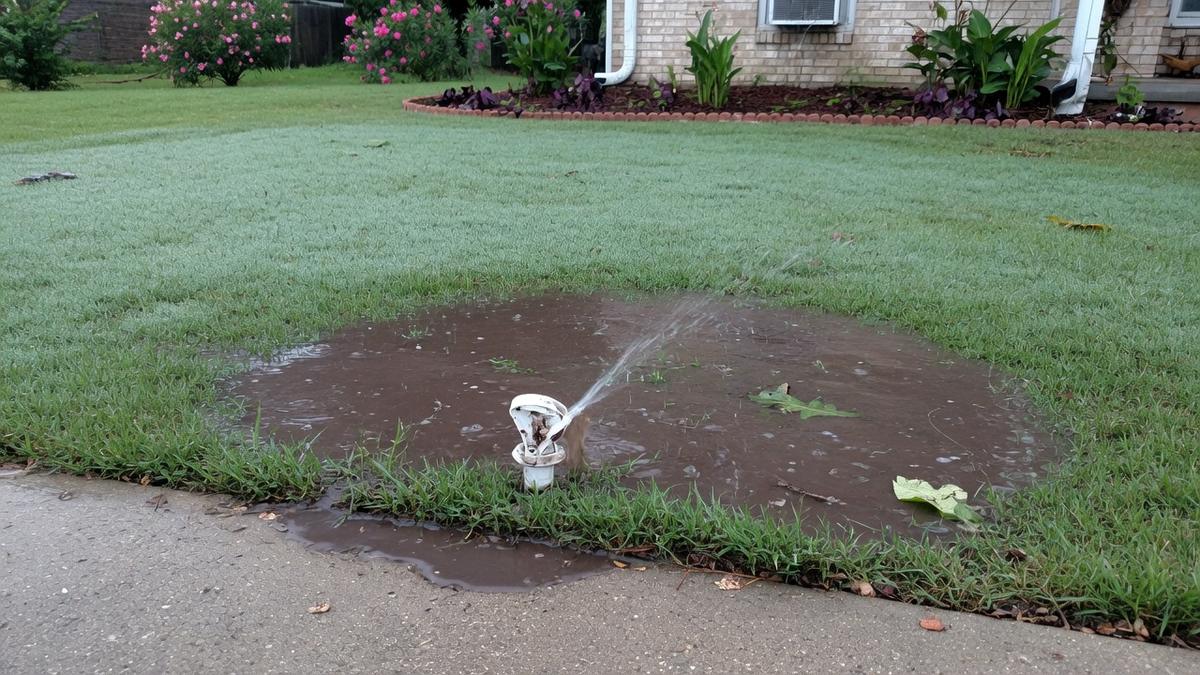
Broken Sprinkler Head Repair in Richmond, Texas starts with water bubbling around a head. A cracked head can flood one spot while leaving the rest of the lawn dry. Around Aliana and Harvest Green, the houses are fast-growing HOA sections plus pecan-shaded older lots with long lateral runs.
A typical call sounds like this. In Long Meadow Farms, in July, when the temptation is to add minutes, someone notices a sideways jet onto the driveway on a corner lot with two parkways. The rest of the yard, toward Veranda, still looks acceptable from the street, which is why the problem gets described as small. It is small only if the station, the valve, and the heads agree. We ask whether the wet or dry area changes while that station runs, and whether it continues after the clock moves on. Those two answers separate a nozzle, a valve, and a leak before we price a part. The soil under that lawn is Brazos bottom clay that stays plastic after rain and hard after a dry spell. The turf is mostly St. Augustine, sometimes Bermuda on the newer open sections. A schedule copied from a different turf or a sunnier neighborhood will not survive contact with this yard. Water service here is Fort Bend municipal utility districts and, in the older core, city water. Any day-of-week rule has to come from the current notice for this address, not from a metro-wide chart.
What the system is actually doing
A sprinkler head fails in a few repeatable ways. The body cracks and floods one point. The riser snaps and the nozzle waters sideways. The turret sticks down and the spray never clears the grass. The nozzle clogs and a wedge of the zone goes dry while the rest looks fine. Those are different parts, and the surrounding heads tell you which story you are in.
Mowers and edgers do a share of the damage, especially in May when the turf hides a head that settled over the winter. Clay movement does the rest. A head that was flush in March can sit proud in August, or sink into a soft spot and water the thatch from below. Raising every head on the zone is sometimes the real repair. Replacing one cracked body is sometimes enough.
Nozzle choice matters as much as the body. A spray nozzle and a rotor do not belong on the same station if you care about matched precipitation. A nozzle with the wrong arc will hit the walk no matter how new the head is. We match the replacement to the zone that is already there, then run it and watch where the water lands.
If sediment returns to the same nozzle every month, the head is not the source. Grit is traveling in the lateral. Cleaning the screen is maintenance. Finding the grit is leak and pipe work, which is a different visit from a simple head swap.
The ground under Richmond
Richmond is two jobs. Pecan Grove is mature trees, longer laterals, and fittings with age. Aliana, Harvest Green, Long Meadow Farms, and Veranda are newer sections where the heads should still be at grade and often are not, because the soil settled or the mower found them. Brazos-bottom clay stays soft after rain, which hides a leak inside a yard that is wet everywhere. We run the station anyway.
Landmarks we use to talk about the route include the Brazos River, the historic Richmond square, and the Pecan Grove canopy. ZIPs we see often are 77406, 77407, 77469, though the utility on the bill matters more than the ZIP. Service is Fort Bend municipal utility districts and, in the older core, city water. If a drought stage or a day-of-week rule is in effect, it is the one that provider published for this address. Our guide to checking watering restrictions is a method, not a live legal notice.
A pass through Richmond neighborhoods
These are the sections we mean when we say Richmond: Aliana, Harvest Green, Long Meadow Farms, Pecan Grove, Veranda. A visit for this problem does not look identical in each of them.
Aliana is where mower damage shows up as a fan that never leaves the ground. St. Augustine grows over a head that settled, the nozzle cracks, and the zone floods a circle while the far edge dries. We replace the body only if it is split, raise it to grade, and pack soil so the next mowing does not bury the new one. The walk gets watched while the station runs. A new head aimed at concrete is not a repair.
In Harvest Green the failure is often a riser, not the cap. Edging along a curved bed snaps the fitting under a head that still looks intact from above. Water sheets out at soil level. Downstream heads on that station get lazy because pressure already left. The riser and the nozzle are matched to whatever the rest of the zone is using, then the station is run beside a healthy one.
Long Meadow Farms rotors drift. Clay movement (Brazos bottom clay that stays plastic after rain and hard after a dry spell) tilts the body a few degrees and the arc that used to stop at the lawn now wets the drive. Turning the arc screw without resetting the body puts the stop in the wrong place again next week. We reset height and level first. Grit in the screen is cleaned if the stream is a pencil instead of a fan.
Side yards in Pecan Grove hide broken heads behind gates and AC pads. A cracked nozzle there soaks the fence and starves the strip of Bermuda on the newer open sections. Count the heads before adding another. These lots are fast-growing HOA sections plus pecan-shaded older lots with long lateral runs, and an extra head on a narrow run is how pressure dies. One matched replacement is the usual fix.
Veranda is where a ‘broken head’ is sometimes a head that was fine until the bed moved. The nozzle still pops. It just waters mulch, or a new walk, or the trunk of a tree that was not in the original arc. We re-aim or change the nozzle pattern. If the body is sound we do not sell a new one to solve a layout change.
How the diagnosis runs in Richmond
- Run the zone and find the head that does not match its neighbors.
- Check the body, riser, nozzle, and height against grade.
- Replace only the failed pieces, matched to the zone.
- Watch the walk and the next head while it runs.
- Clean the filter if grit caused the pattern.
That sequence is the same standard we use on broken sprinkler head repair across the metro. The local part is the yard: Richmond combines established areas with fast-growing communities and a wide range of lot sizes and irrigation layouts.
What we will not pretend
A photograph is not a diagnosis. A water bill is not a location. A smart controller is not a new pipe. Brown turf is not automatically a dry zone: chinch bugs, fungal disease, urine, and shade all imitate missed irrigation, and missed irrigation imitates them. We can test coverage. A turf diagnosis beyond coverage may belong to someone else. Read brown patch or a sprinkler problem and chinch bugs or a dry zone before you drown a lawn that was not thirsty. We also do not publish a flat price for a leak we have not found. Access, the fitting, and the surrounding pipe change the job.
Hiring is regulated in Texas. Ask who will do the work and check the license. Ours is listed as LI 6529. The short version of what that license is for lives in what a Texas licensed irrigator does. Backflow devices protect the drinking-water supply. We do not bypass them to make a zone run. If your provider wants a test, what happens during a backflow test explains the idea without pretending every city uses the same interval.
Questions we hear on this job
What does this look like in Richmond?
People describe water bubbling around a head or a head that stays down. On Brazos bottom clay that stays plastic after rain and hard after a dry spell, we confirm the symptom with the station running before we name a part. Construction activity, settling, bed changes, and long lateral lines can lead to leaks, low pressure, or heads that no longer sit at grade.
Will a longer watering schedule fix it?
Not if the pattern is uneven or water is escaping. Extra minutes amplify a leak or a bad nozzle. We repair the fault, then set the clock to the turf and to your utility’s current rules.
How do I shut it off if water will not stop?
If you can do it safely, close the irrigation isolation valve near the backflow device. Turning off the controller does not stop a valve that is stuck open. Then call 346-642-6161 and say which part of the yard is wet.
Where to go next
The money page for this work is broken sprinkler head repair. If you are in Richmond, start with the Richmond service area and the local page for broken sprinkler heads in Richmond. Nearby, we also cover The Woodlands and Rosenberg. Related repairs: sprinkler leaks and sprinkler valves. Keep reading: Rotor adjustment for larger lawns, August clay cracks and the fitting that finally lets go, Builder irrigation after the warranty year. To book the visit, use the contact form or call 346-642-6161. The full library sits on the field notes index.
Houston Sprinkler Repair schedules this work by phone at 346-642-6161. Tell us the city, the symptom, and whether water is moving right now. If you want the broader map first, the service area index lists every city, and all repairs lists every service.