
August 17, 2025 · The Woodlands
How we diagnose an irrigation inspection on a Houston-area lawn
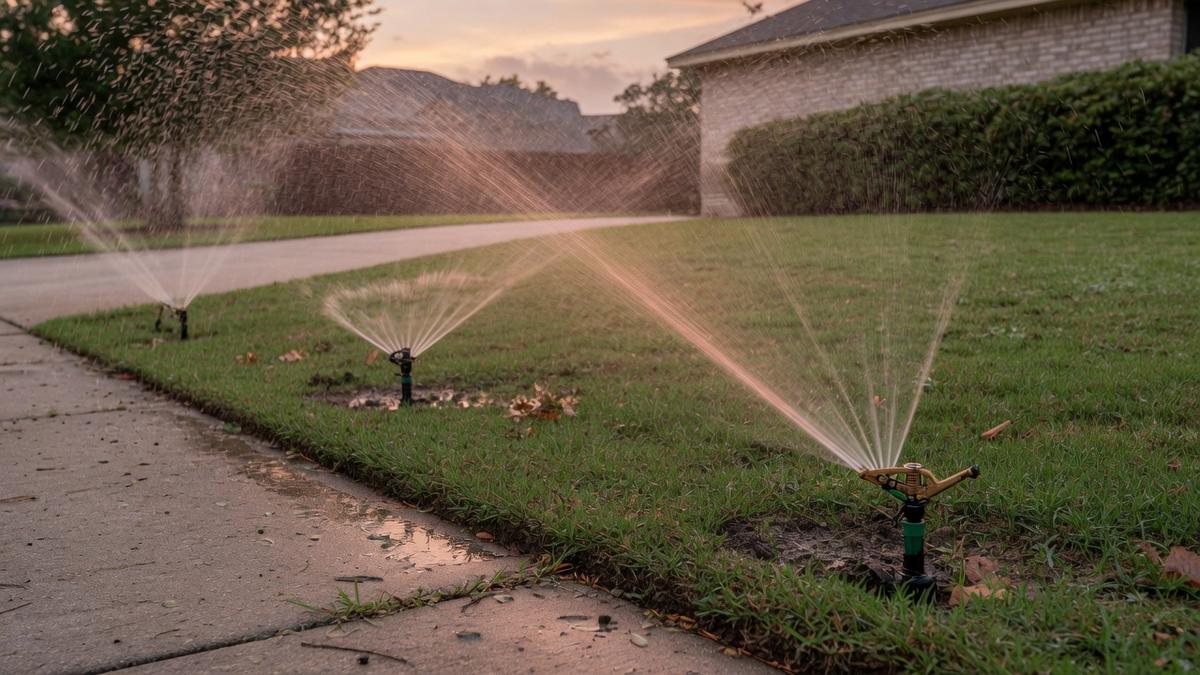
A full system check finds small coverage problems before they become larger water losses.
A typical call sounds like this. In Alden Bridge, a week after a short Gulf freeze, someone notices a house you just bought on a builder front lawn. The rest of the yard, toward Indian Springs, still looks acceptable from the street, which is why the problem gets described as small. It is small only if the station, the valve, and the heads agree. We ask whether the wet or dry area changes while that station runs, and whether it continues after the clock moves on. Those two answers separate a nozzle, a valve, and a leak before we price a part. The soil under that lawn is sandy loam over clay, with roots filling the top foot under the canopy. The turf is mostly St. Augustine, sometimes shade-thinned St. Augustine where the pines close in. A schedule copied from a different turf or a sunnier neighborhood will not survive contact with this yard. Water service here is municipal utility districts serving The Woodlands Township villages. Any day-of-week rule has to come from the current notice for this address, not from a metro-wide chart.
This guide is the diagnostic version of our irrigation system inspection page. The The Woodlands notes below are one market. The same fault shows up in every city we cover, with different soil and shade.
What the system is actually doing
An inspection is every station, run long enough to see the pattern, with notes. We look for leaks, tilted heads, overspray, buried heads, valve-box condition, controller programs, and the rain sensor. You get a list of what should be repaired now and what can wait. That is a different product from a repair visit that opens with an active leak.
The best time is after a freeze, after a landscape project, after you buy the house, and before summer schedules go in. A system that 'comes on' can still be watering the fence. The inspection is how you find that while the correction is a nozzle instead of a brown patch and a theory.
We do not invent a water-bill savings number. If a stuck valve or a broken head is running for hours, stopping it reduces waste. If the system is already tight, an inspection is documentation, not a guarantee of a lower bill.
Backflow equipment is noted, not casually bypassed. If your provider requires a test, that test is a separate qualified task with its own report. An irrigation inspection can tell you the device is there and whether it is obviously damaged.
The ground under The Woodlands
The Woodlands canopy is the design. Alden Bridge, Cochran’s Crossing, Indian Springs, Panther Creek, and Sterling Ridge all put turf, beds, and roots in the same shade. Heads grow over. Pipe shares the topsoil with feeder roots. A schedule copied from a Katy front lawn will keep these beds too wet and still miss a sunny pocket by the drive. Village covenants also mean the finished grade and the beds have to look like they belong when we leave.
Landmarks we use to talk about the route include The Woodlands Waterway, the village paths, and the pine canopy that predates many of the houses. ZIPs we see often are 77381, 77380, 77382, 77389, though the utility on the bill matters more than the ZIP. Service is municipal utility districts serving The Woodlands Township villages. If a drought stage or a day-of-week rule is in effect, it is the one that provider published for this address. Our guide to checking watering restrictions is a method, not a live legal notice.
A pass through The Woodlands neighborhoods
These are the sections we mean when we say The Woodlands: Alden Bridge, Cochran's Crossing, Indian Springs, Panther Creek, Sterling Ridge. A visit for this problem does not look identical in each of them.
An inspection in Alden Bridge is a daylight lap. Every station runs long enough to see overspray, not just a click. We note the backflow device without bypassing it, the controller programs, and any head watering the walk. You get a written split between ‘wasting water now’ and ‘can wait.’ ZIP 77381 houses often have never had that list.
Cochran’s Crossing inspections catch heads the turf swallowed and programs still set for July. St. Augustine hides a low head until the ring is brown. We raise and aim during the visit when the fix is adjustment. Leaks and bad valves are quoted, not quietly ignored so the inspection looks ‘all clear.’
Buying in Indian Springs is the inspection we would want before closing if the seller’s report says sprinklers were not tested. We run them. A stuck valve or a broken lateral is cheaper to know about now. We do not turn that into a scare. We say what ran and what did not.
Panther Creek shade and Sterling Ridge sun should not share a copied runtime. The inspection writes them as different stations or flags that they are trapped on one. Sandy loam over clay, with roots filling the top foot under the canopy changes how fast a puddle should disappear. A puddle that remains after the station has been off for an hour is noted as a possible leak, then tested.
After a freeze or a landscape redo, Sterling Ridge needs the inspection more than a new clock does. Above-grade breaks, buried heads, and zones aimed at the new walk are the finds. The sensor is put back in the circuit if someone bypassed it in summer and forgot. Maintenance items are listed separately from repairs.
How the diagnosis runs in The Woodlands
- Walk the property and note backflow, controller, and visible heads.
- Run every station.
- Record leaks, overspray, buried heads, and bad programs.
- Separate repairs that waste water now from items that can wait.
- Leave station names a homeowner can reuse.
That sequence is the same standard we use on irrigation system inspection across the metro. The local part is the yard: The Woodlands is known for mature trees and layered landscapes where turf, beds, roots, and shade can vary significantly across one property.
What we will not pretend
A photograph is not a diagnosis. A water bill is not a location. A smart controller is not a new pipe. Brown turf is not automatically a dry zone: chinch bugs, fungal disease, urine, and shade all imitate missed irrigation, and missed irrigation imitates them. We can test coverage. A turf diagnosis beyond coverage may belong to someone else. Read brown patch or a sprinkler problem and chinch bugs or a dry zone before you drown a lawn that was not thirsty. We also do not publish a flat price for a leak we have not found. Access, the fitting, and the surrounding pipe change the job.
Hiring is regulated in Texas. Ask who will do the work and check the license. Ours is listed as LI 6529. The short version of what that license is for lives in what a Texas licensed irrigator does. Backflow devices protect the drinking-water supply. We do not bypass them to make a zone run. If your provider wants a test, what happens during a backflow test explains the idea without pretending every city uses the same interval.
Questions we hear on this job
What does this look like in The Woodlands?
People describe a house you just bought or coverage that changed with the season. On sandy loam over clay, with roots filling the top foot under the canopy, we confirm the symptom with the station running before we name a part. Roots and dense shade can affect buried lines, head placement, and how quickly different parts of a zone dry.
Will a longer watering schedule fix it?
Not if the pattern is uneven or water is escaping. Extra minutes amplify a leak or a bad nozzle. We repair the fault, then set the clock to the turf and to your utility’s current rules.
How do I shut it off if water will not stop?
If you can do it safely, close the irrigation isolation valve near the backflow device. Turning off the controller does not stop a valve that is stuck open. Then call 346-642-6161 and say which part of the yard is wet.
Where to go next
The money page for this work is irrigation system inspection. If you are in The Woodlands, start with the The Woodlands service area and the local page for an irrigation inspection in The Woodlands. Nearby, we also cover Tomball and Richmond. Related repairs: home sprinkler repair and commercial sprinkler repair. Keep reading: What happens during a backflow test?, Why The Woodlands calls about an irrigation inspection, Houston systems are rarely 'winterized' the northern way. To book the visit, use the contact form or call 346-642-6161. The full library sits on the field notes index.
Houston Sprinkler Repair schedules this work by phone at 346-642-6161. Tell us the city, the symptom, and whether water is moving right now. If you want the broader map first, the service area index lists every city, and all repairs lists every service.