
November 20, 2025 · Spring
low sprinkler pressure on Spring clay and St. Augustine
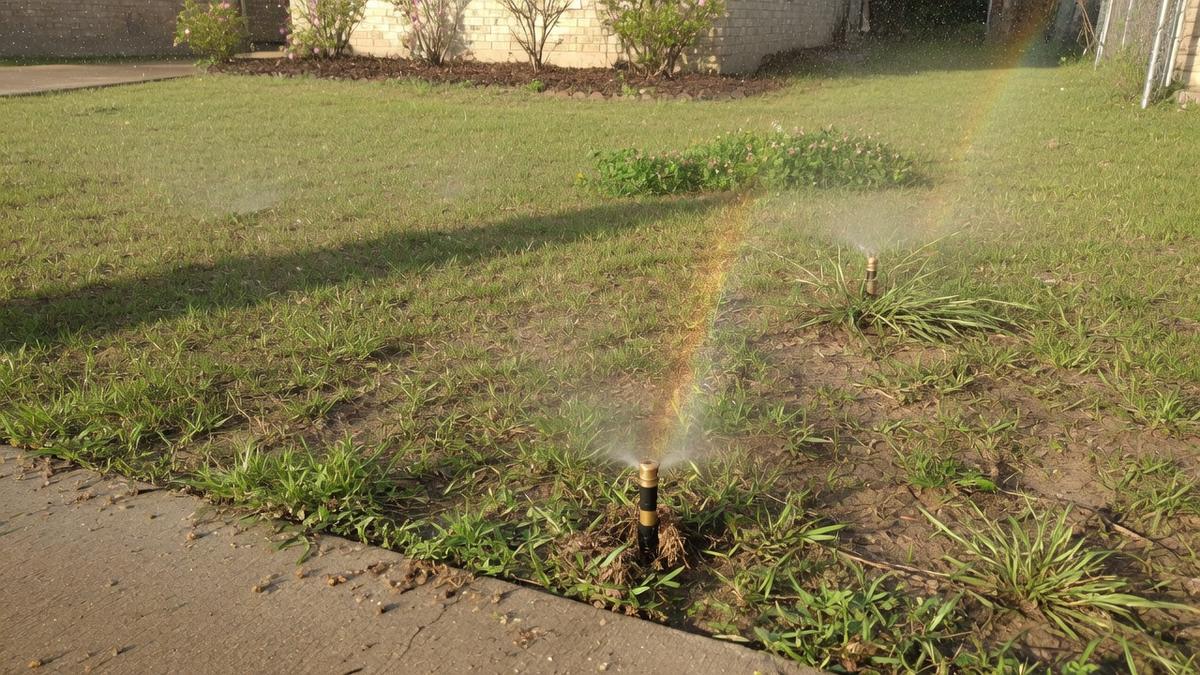
Low Sprinkler Pressure Repair in Spring, Texas starts with heads that barely rise. Weak spray can come from a leak, an obstruction, a valve, or a supply-side change. Around Old Town Spring and Gleannloch Farms, the houses are wooded acreage-style lots, golf-community lawns, and older Spring houses with valves lost under years of mulch.
A typical call sounds like this. In Gleannloch Farms, in October, with last summer’s program still loaded, someone notices mist so fine it never reaches the lawn on a shaded back yard. The rest of the yard, toward Spring Creek Oaks, still looks acceptable from the street, which is why the problem gets described as small. It is small only if the station, the valve, and the heads agree. We ask whether the wet or dry area changes while that station runs, and whether it continues after the clock moves on. Those two answers separate a nozzle, a valve, and a leak before we price a part. The soil under that lawn is a mix of clay and sandier forest soils, especially north toward the Woodlands line. The turf is mostly St. Augustine, sometimes Bermuda where the canopy opens up. A schedule copied from a different turf or a sunnier neighborhood will not survive contact with this yard. Water service here is municipal utility districts and private water systems that do not share one rule sheet. Any day-of-week rule has to come from the current notice for this address, not from a metro-wide chart.
What the system is actually doing
Low pressure is a location problem before it is a parts problem. If every zone is weak, look at the supply: a partly closed valve, a clogged filter, a master valve that is not opening fully, or a utility-side change. If one zone is weak, the loss is on that station: a leak, a valve that is barely open, too many heads, or a clogged nozzle screening the flow.
Mist is the opposite complaint and people describe it as low pressure anyway. Fine fog at the head usually means pressure is too high, not too low, and the water is atomizing before it reaches the turf. Regulation belongs in that system only after a gauge says so. A regulator will not heal a leak that is the real reason another zone is weak.
Adding heads to a zone that was already at the edge of available flow makes every head shorter. The repair is sometimes a new station, not a box of nozzles. We would rather say so than sell parts that cannot change the gallons per minute you actually have.
Runtime is not pressure. A longer cycle on a weak zone overwaters the first few feet and still misses the bed. Fix the loss, then set the minutes.
The ground under Spring
Spring yards share space with trees. Gleannloch and Windrose can look like a golf-community spec. Old Town and the wooded streets are roots, shade, and valve boxes that disappeared under mulch. A dry sunny strip and a sour shaded bed on the same station are a layout problem. Northgate and Spring Creek Oaks add newer pipe to that mix. Pressure and sun have to be looked at separately.
Landmarks we use to talk about the route include Old Town Spring, Spring Creek, and the Gleannloch lakes. ZIPs we see often are 77373, 77379, 77388, though the utility on the bill matters more than the ZIP. Service is municipal utility districts and private water systems that do not share one rule sheet. If a drought stage or a day-of-week rule is in effect, it is the one that provider published for this address. Our guide to checking watering restrictions is a method, not a live legal notice.
A pass through Spring neighborhoods
These are the sections we mean when we say Spring: Old Town Spring, Gleannloch Farms, Windrose, Spring Creek Oaks, Northgate Crossing. A visit for this problem does not look identical in each of them.
If every station in Old Town Spring is short, the zone nozzles are not the first stop. A partly closed supply valve, a clogged filter, or a master valve that only cracks open will starve the whole property. We check those before we touch a head. Municipal utility districts and private water systems that do not share one rule sheet pressure also changes. The number at the last house is not a measurement at this meter.
One weak zone in Gleannloch Farms, with the others normal, is a leak, a stuck valve, a clog, or too many heads for the flow. Builder layouts on wooded acreage-style lots, golf-community lawns, and older Spring houses with valves lost under years of mulch sometimes stack a station past what the meter can give. Splitting that station is the repair. A longer runtime only puddles the first head.
Mist over Windrose gets reported as low pressure and it is often the opposite. Fog means the water is atomizing. A regulator is a considered addition after a gauge reading, not a guess. Regulation will not close a leak that is the real reason Spring Creek Oaks is weak on a different station.
The far corner of Northgate Crossing is where low pressure is obvious and where people add minutes. The near heads are already drowning. We fix the loss, then we set time. St. Augustine shows the stripe. Bermuda where the canopy opens up may hide it longer. Either way the pattern, not the clock, is the diagnosis.
Side yards in Spring Creek Oaks lose pressure because the run is long and the pipe is small. Adding a head to ‘cover the gate’ makes the rest of the strip worse. We count flow before we add anything. If the zone is already at its limit, the honest sentence is that the layout has to change, not that a nozzle catalog will save it.
How the diagnosis runs in Spring
- Decide if one zone is weak or every zone is weak.
- Look at supply valves, filters, and the master valve for a system-wide drop.
- Look at leaks, clogs, and head count for a single-zone drop.
- Measure before adding regulation or heads.
- Retest the far head, not just the first one.
That sequence is the same standard we use on low sprinkler pressure repair across the metro. The local part is the yard: Spring has wooded lots, established subdivisions, and newer developments where irrigation lines often share space with roots and changing landscapes.
What we will not pretend
A photograph is not a diagnosis. A water bill is not a location. A smart controller is not a new pipe. Brown turf is not automatically a dry zone: chinch bugs, fungal disease, urine, and shade all imitate missed irrigation, and missed irrigation imitates them. We can test coverage. A turf diagnosis beyond coverage may belong to someone else. Read brown patch or a sprinkler problem and chinch bugs or a dry zone before you drown a lawn that was not thirsty. We also do not publish a flat price for a leak we have not found. Access, the fitting, and the surrounding pipe change the job.
Hiring is regulated in Texas. Ask who will do the work and check the license. Ours is listed as LI 6529. The short version of what that license is for lives in what a Texas licensed irrigator does. Backflow devices protect the drinking-water supply. We do not bypass them to make a zone run. If your provider wants a test, what happens during a backflow test explains the idea without pretending every city uses the same interval.
Questions we hear on this job
How do I shut it off if water will not stop?
If you can do it safely, close the irrigation isolation valve near the backflow device. Turning off the controller does not stop a valve that is stuck open. Then call 346-642-6161 and say which part of the yard is wet.
Do you repair low sprinkler pressure in Spring?
Yes. We schedule low sprinkler pressure repair across Spring, including Old Town Spring and Gleannloch Farms. Call to confirm the address is inside the current route. The listed license is Texas irrigator LI 6529.
What does this look like in Spring?
People describe heads that barely rise or coverage that dies before the bed line. On a mix of clay and sandier forest soils, especially north toward the Woodlands line, we confirm the symptom with the station running before we name a part. Shade, mature trees, soil movement, and buried valve boxes can complicate otherwise straightforward coverage problems.
Where to go next
The money page for this work is low sprinkler pressure repair. If you are in Spring, start with the Spring service area and the local page for low sprinkler pressure in Spring. Nearby, we also cover Pearland and Tomball. Related repairs: an irrigation inspection and home sprinkler repair. Keep reading: A partly closed gate valve masquerading as a bad clock, How we diagnose low sprinkler pressure on a Houston-area lawn, How we diagnose a dead sprinkler zone on a Houston-area lawn. To book the visit, use the contact form or call 346-642-6161. The full library sits on the field notes index.
Houston Sprinkler Repair schedules this work by phone at 346-642-6161. Tell us the city, the symptom, and whether water is moving right now. If you want the broader map first, the service area index lists every city, and all repairs lists every service.