
May 23, 2026 · Sugar Land
Valve rebuild or replacement?
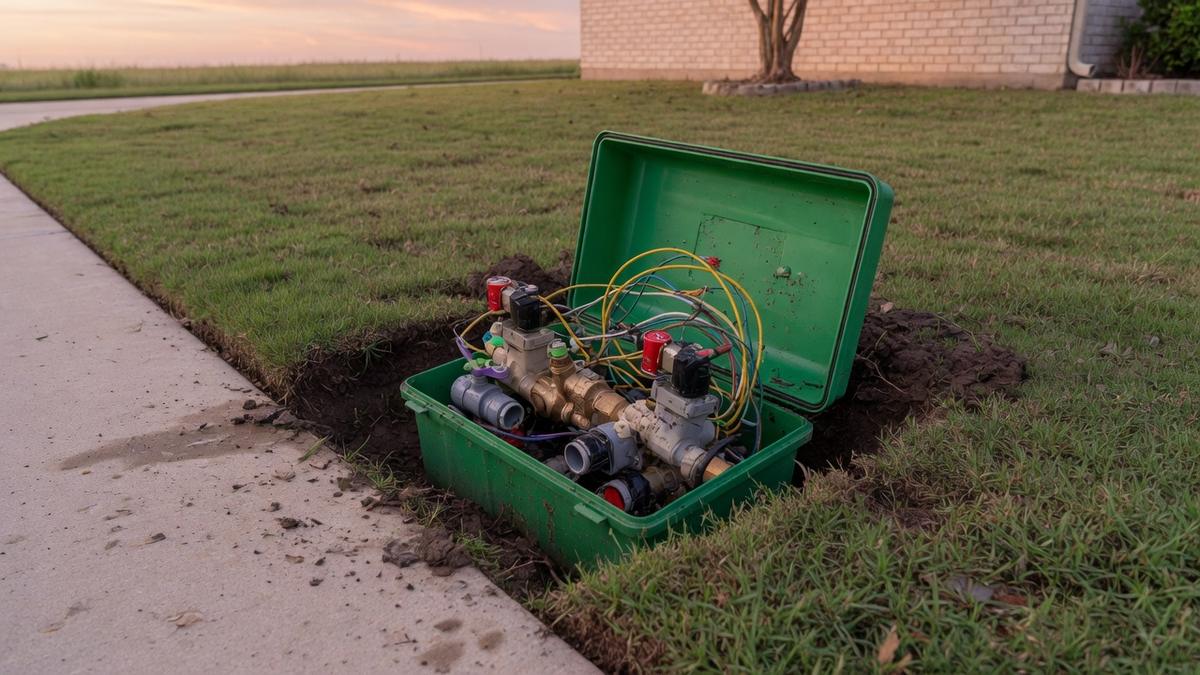
A failed internal part does not always require replacing the entire valve body.
Test whether the fault is electrical, debris-related, or a damaged diaphragm or body. Compare compatible repair parts with full replacement after examining the assembly.
Repeated failures may indicate a broader pressure or contamination issue.
Where this shows up around Sugar Land
A typical call sounds like this. In Telfair, a week after a short Gulf freeze, someone notices a zone that runs after the clock has moved on on a side yard you can barely walk. The rest of the yard, toward First Colony, still looks acceptable from the street, which is why the problem gets described as small. It is small only if the station, the valve, and the heads agree. We ask whether the wet or dry area changes while that station runs, and whether it continues after the clock moves on. Those two answers separate a nozzle, a valve, and a leak before we price a part. The soil under that lawn is heavy Fort Bend clay that heaves sidewalks and irrigation fittings together. The turf is mostly St. Augustine, sometimes trimmed Bermuda on a few athletic and common areas. A schedule copied from a different turf or a sunnier neighborhood will not survive contact with this yard. Water service here is the City of Sugar Land or a Fort Bend municipal utility district. Any day-of-week rule has to come from the current notice for this address, not from a metro-wide chart.
Sugar Land HOAs notice water on concrete and brown lace in the parkway. First Colony and Greatwood have mature trees and valves that have been in the ground since the first landscape. Telfair and Riverstone add newer clocks and tighter architectural rules. The repair has to leave the lawn and the walk both presentable. A head aimed at the curb will generate another letter even if the turf is perfect.
What the system is actually doing
A zone valve is a diaphragm, a spring, a solenoid, and a body, sitting in a box that Houston mowers and mulch both try to bury. When it sticks open, that station runs after the controller has moved on. When it will not open, the station is dry and the other stations look normal. Those two symptoms are not the same part, which is why we test before we replace the body.
Electrical faults imitate mechanical ones. A solenoid that does not pull, a common wire that has corroded in a wet box, or a controller station with no output all leave the valve shut. We check for voltage at the solenoid and look at the wire splices before we decide the brass or plastic body is done. A rebuild kit is the right repair when the diaphragm is torn and the body is sound. A new valve is the right repair when the body is cracked or the threads are gone.
Debris in the valve box is a Houston classic. A crushed lid lets soil sit on the diaphragm. The valve then refuses to seal and the homeowner hears water in the box all afternoon. The repair includes a lid that can survive the mower, not only a new diaphragm that will foul again.
Manifolds with several valves in one box need a written scope. One bad solenoid is not a reason to replace every valve beside it, and one cracked body next to rotten pipe is not a one-part job. We separate diagnosis, materials, and labor so the price matches what we opened.
The ground under Sugar Land
Sugar Land HOAs notice water on concrete and brown lace in the parkway. First Colony and Greatwood have mature trees and valves that have been in the ground since the first landscape. Telfair and Riverstone add newer clocks and tighter architectural rules. The repair has to leave the lawn and the walk both presentable. A head aimed at the curb will generate another letter even if the turf is perfect.
Landmarks we use to talk about the route include First Colony oaks, the Sugar Land town square, and the Brazos River levee. ZIPs we see often are 77479, 77478, 77498, though the utility on the bill matters more than the ZIP. Service is the City of Sugar Land or a Fort Bend municipal utility district. If a drought stage or a day-of-week rule is in effect, it is the one that provider published for this address. Our guide to checking watering restrictions is a method, not a live legal notice.
A pass through Sugar Land neighborhoods
These are the sections we mean when we say Sugar Land: First Colony, Greatwood, New Territory, Telfair, Riverstone. A visit for this problem does not look identical in each of them.
First Colony valve boxes sit in parkways and get mowed into the soil. A crushed lid fills the box, and soil on the diaphragm holds the station open. The yard stays wet in St. Augustine long after the display has moved on. The repair is the diaphragm or the debris, plus a lid that can take a mower. Replacing the controller does not empty a buried box.
In Greatwood we see solenoids that buzz and valves that do not move. The electrical call is reaching the box. The mechanical valve is stuck or the plunger is fouled. We test the solenoid before the body is condemned. A rebuild kit is enough when the housing threads are clean. A cracked body gets a new valve, not a hope.
New Territory manifolds often serve two yards’ worth of stations in one box, especially on mature first-generation master plans and newer sections still under HOA review. One rotten wire nut takes out the station whose splice failed, not every valve beside it. Connectors get remade dry. We label which valve feeds which lawn so the next trip is not a guessing game between this section and Telfair.
A valve that never opens in Telfair still needs a working neighbor for comparison. If the next station on the same manifold runs, supply and the master valve are probably fine. The fault is this solenoid, this diaphragm, or the wire to this terminal. We do not replace the clock because one zone is quiet.
Riverstone has valves lost under years of mulch. Finding the box is part of the job: controller labels, the direction of the lateral, a careful probe. Blind digging is how a wire gets cut and a one-zone problem becomes three. Once the lid is up, the same tests apply. The box is left visible enough to find next time.
How the diagnosis runs in Sugar Land
- Confirm the controller is or is not still calling for the station.
- Open the box and look for water, soil, and broken wire nuts.
- Test the solenoid and the diaphragm separately.
- Rebuild or replace the valve that failed, not the whole manifold by default.
- Run the station and the next one.
That sequence is the same standard we use on sprinkler valve repair across the metro. The local part is the yard: Sugar Land yards commonly include mature neighborhoods, planned communities, landscaped beds, and closely managed curb appeal.
What we will not pretend
A photograph is not a diagnosis. A water bill is not a location. A smart controller is not a new pipe. Brown turf is not automatically a dry zone: chinch bugs, fungal disease, urine, and shade all imitate missed irrigation, and missed irrigation imitates them. We can test coverage. A turf diagnosis beyond coverage may belong to someone else. Read brown patch or a sprinkler problem and chinch bugs or a dry zone before you drown a lawn that was not thirsty. We also do not publish a flat price for a leak we have not found. Access, the fitting, and the surrounding pipe change the job.
Hiring is regulated in Texas. Ask who will do the work and check the license. Ours is listed as LI 6529. The short version of what that license is for lives in what a Texas licensed irrigator does. Backflow devices protect the drinking-water supply. We do not bypass them to make a zone run. If your provider wants a test, what happens during a backflow test explains the idea without pretending every city uses the same interval.
Questions we hear on this job
How do I shut it off if water will not stop?
If you can do it safely, close the irrigation isolation valve near the backflow device. Turning off the controller does not stop a valve that is stuck open. Then call 346-642-6161 and say which part of the yard is wet.
Do you repair sprinkler valves in Sugar Land?
Yes. We schedule sprinkler valve repair across Sugar Land, including First Colony and Greatwood. Call to confirm the address is inside the current route. The listed license is Texas irrigator LI 6529.
What does this look like in Sugar Land?
People describe a zone that runs after the clock has moved on or one station that never opens. On heavy Fort Bend clay that heaves sidewalks and irrigation fittings together, we confirm the symptom with the station running before we name a part. Tree roots, shifting clay, blocked spray patterns, and aging valves can create uneven watering even when the controller still runs normally.
Where to go next
The money page for this work is sprinkler valve repair. If you are in Sugar Land, start with the Sugar Land service area and the local page for sprinkler valves in Sugar Land. Nearby, we also cover Cypress and Pearland. Related repairs: sprinkler controllers and a dead sprinkler zone. Keep reading: How we diagnose sprinkler valves on a Houston-area lawn, April controller programs that still think it is July, Is a brown lawn patch a sprinkler problem?. To book the visit, use the contact form or call 346-642-6161. The full library sits on the field notes index.
Repeated failures may indicate a broader pressure or contamination issue. If that boundary describes your yard, say so when you call.
Houston Sprinkler Repair schedules this work by phone at 346-642-6161. Tell us the city, the symptom, and whether water is moving right now. If you want the broader map first, the service area index lists every city, and all repairs lists every service.